

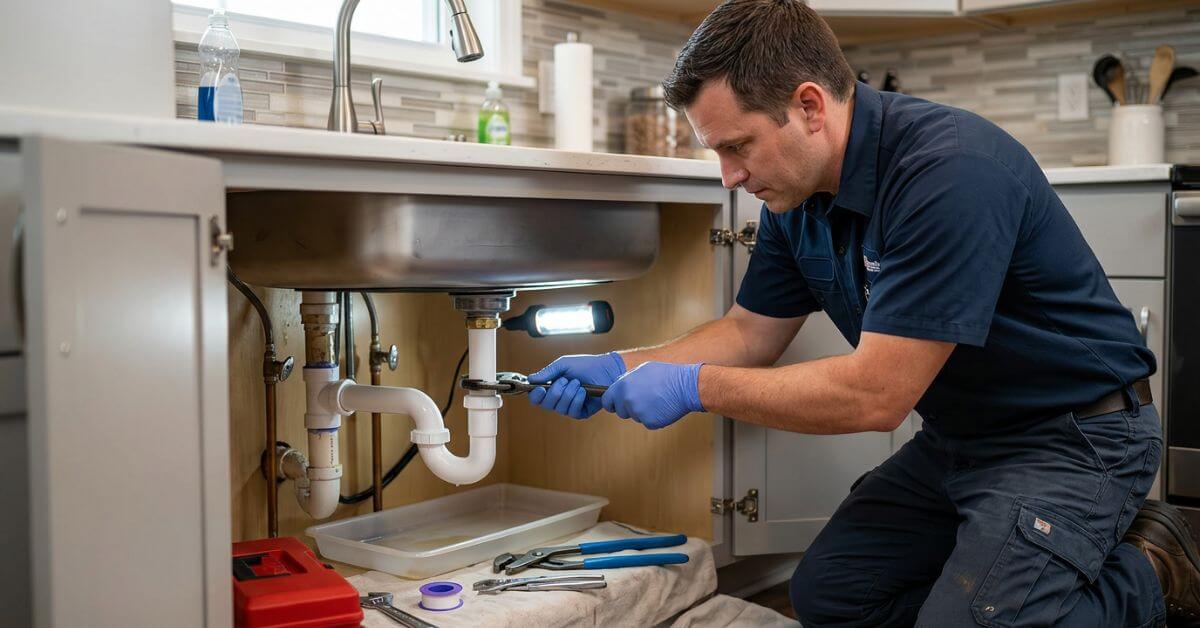
Kitchen Plumbing Repair
The kitchen is the hardest working room in your home and the plumbing takes the most punishment. Grease, food waste, soap buildup, and daily heavy use all add up. When something goes wrong, it rarely fixes itself.
A slow drain becomes a full blockage. A small drip under the sink turns into water damage inside the cabinet. A loose fitting leads to a leak that you don’t notice until the floor starts to warp.
The good news is that most kitchen plumbing problems are fixable many without calling a plumber. This guide walks you through the most common issues, how to diagnose them, what to do about them, and when it’s smarter to hand the job over to a professional.
What Is Kitchen Plumbing Repair?
Kitchen plumbing repair covers any work done to fix faults in a kitchen’s water supply or drainage system. This includes repairing or replacing sink drains, fixing leaking pipes and fittings, clearing blocked waste lines, repairing or replacing faucets and shut-off valves, and addressing issues with dishwasher or garbage disposal connections. Repairs range from simple DIY tasks to jobs that require a licensed plumber.
Quick Summary
- The most common kitchen plumbing problems are blocked drains, leaking pipes, dripping faucets, and low water pressure
- Many minor repairs are safe to do yourself with basic tools
- Always turn off the water supply before starting any repair
- Persistent leaks, pipe damage inside walls, and gas-connected appliances need a professional
- Regular maintenance prevents most kitchen plumbing issues before they start
Why Kitchen Plumbing Problems Deserve Quick Attention
A dripping faucet that loses one drop per second wastes over 3,000 gallons of water per year. A slow drain that turns into a full blockage can back up water into your dishwasher, cause overflow, and damage your kitchen floor or cabinets.
Kitchen plumbing faults also get worse over time — not better. Grease buildup hardens. Small leaks corrode fittings. Loose connections loosen further under water pressure. Acting early is almost always cheaper than waiting.
The Most Common Kitchen Plumbing Problems
Blocked or Slow Kitchen Drain
This is the most frequent kitchen plumbing complaint. The culprit is almost always a buildup of grease, food particles, and soap residue inside the drain pipe.
Signs: Water draining slowly, gurgling sounds, standing water in the sink, bad smell from the drain.
How to fix it:
Start with the simplest approach first.
- Boiling water method: Pour a full kettle of boiling water slowly down the drain. This often melts light grease buildup on its own.
- Baking soda and vinegar: Pour half a cup of baking soda into the drain, followed by half a cup of white vinegar. Let it fizz for 15 minutes, then flush with hot water. This works well for mild blockages.
- Plunger: Use a cup plunger (not a flange plunger — that’s for toilets). Block the overflow hole with a wet cloth, add a few inches of water to the sink, and plunge firmly 10–15 times.
- Drain snake (auger): If the above methods fail, a hand drain snake can reach deeper blockages — typically 15 to 25 feet into the pipe. Feed it slowly, rotate as you push, and pull back the debris.
When to call a plumber: If the blockage keeps returning or multiple drains are slow at the same time, the problem may be in the main waste line — that needs professional equipment.
Leaking Pipes Under the Sink
Leaks under the kitchen sink are common and often go unnoticed until water damage is already done. Most people only find them when they open the cabinet and discover wet shelves or a warped cabinet base.
Common leak points:
- The P-trap (the curved pipe section)
- Drain connections where pipes join
- Supply line connections to the faucet
- Shut-off valve connections
How to fix it:
First, dry the area completely and run the water to identify exactly where the drip is coming from. Then:
- Loose P-trap: Tighten the slip-joint nuts by hand — don’t over-tighten or you’ll crack the fitting. If the P-trap is cracked or corroded, replace it. A new plastic P-trap costs around $5–$10 and takes about 15 minutes to swap out.
- Leaking drain connections: Wrap the threads with PTFE (plumber’s tape) and reassemble the joint. If the fitting is damaged, replace it.
- Supply line leak: Check the compression fittings where the supply lines connect to the faucet and shut-off valve. Tighten carefully. If the supply line itself is leaking, replace it — flexible braided supply lines are inexpensive and easy to install.
A homeowner in Chicago once noticed a musty smell coming from under their kitchen sink. When they checked, the P-trap had been slowly dripping for weeks — the cabinet base had softened and started to mold. A $7 replacement P-trap fixed the leak. The cabinet repair cost $200. Catching it earlier would have saved the cabinet entirely.
Dripping Faucet
A dripping kitchen faucet is more than just annoying — it wastes water and adds to your utility bill every single month. The fix depends on the faucet type.
Common faucet types and their typical fault:
| Faucet Type | Common Cause of Drip | Typical Fix |
|---|---|---|
| Ball faucet | Worn springs or ball | Replace ball and spring kit |
| Cartridge faucet | Worn cartridge | Replace cartridge |
| Ceramic disc faucet | Cracked or dirty disc | Clean or replace ceramic disc |
| Compression faucet | Worn rubber washer | Replace washer and O-ring |
Basic repair steps (all types):
- Turn off the water supply valves under the sink
- Open the faucet to release pressure
- Remove the handle (usually one screw under a decorative cap)
- Identify and replace the worn part
- Reassemble and test
Faucet repair kits are available at most hardware stores for $10–$25. If the faucet body itself is cracked or heavily corroded, replacement is more practical than repair.
Low Water Pressure at the Kitchen Faucet
If your kitchen faucet has suddenly lost pressure — or has always been weak — the cause is usually one of these:
- Clogged aerator: The aerator is the small mesh screen at the tip of the faucet spout. It collects mineral deposits over time and restricts flow. Unscrew it, soak it in white vinegar for 30 minutes, rinse, and reinstall. This fix takes five minutes and costs nothing.
- Partially closed shut-off valve: Check the valves under the sink. If one was bumped and turned partially closed, that restricts flow. Turn it fully counterclockwise to open.
- Kinked or damaged supply line: If the flexible supply line under the sink is bent or kinked, it restricts water flow. Straighten it or replace it.
- Wider pressure issue: If pressure is low at every faucet in the house, the problem is at the main supply or pressure reducing valve — that needs a plumber.
Garbage Disposal Problems
If you have a garbage disposal unit, it adds another set of potential plumbing issues to your kitchen.
Common problems:
- Disposal won’t turn on: Press the reset button on the bottom of the unit. If it still won’t start, check the circuit breaker.
- Humming but not spinning: Something is jammed. Turn off the power completely, use the hex key (Allen wrench) in the port at the bottom of the unit to manually free the grinding plate, then clear the jam with pliers — never your hand.
- Disposal leaking: Leaks from the top usually mean the mounting flange needs resealing. Leaks from the side or bottom often mean internal seals have failed — at that point, replacement is more practical than repair.
- Slow draining after disposal: The drain connection to the disposal unit may be clogged with food buildup. Disconnect and clear the drain line.
Dishwasher Drainage Issues
A dishwasher that doesn’t drain properly is often a kitchen plumbing problem, not an appliance fault.
Check these first:
- The drain hose connecting the dishwasher to the sink drain — it should loop up high before connecting (called a high loop) to prevent backflow
- The knockout plug in the garbage disposal inlet — if a new disposal was installed and this plug wasn’t removed, the dishwasher won’t drain
- The drain filter inside the dishwasher — clean it monthly
If the dishwasher drain hose is cracked or the connection at the sink is leaking, replacing the hose is a straightforward DIY job.
Tools You’ll Need for Basic Kitchen Plumbing Repairs
You don’t need a full professional toolkit. These basics cover most kitchen plumbing jobs:
- Adjustable wrench and pliers
- Plumber’s tape (PTFE tape)
- Cup plunger
- Hand drain snake
- Bucket and towels
- Flashlight or headlamp
- Replacement washers, O-rings, and P-trap fittings
- White vinegar (for descaling aerators and drains)
Most of these cost under $50 in total and handle the majority of common kitchen plumbing repairs.
When to Stop and Call a Plumber
Some kitchen plumbing jobs go beyond what a homeowner should attempt. Call a licensed plumber if:
- The leak is coming from inside a wall or under the floor
- You’ve cleared the drain but it keeps blocking — there may be a deeper obstruction or pipe damage
- The shut-off valve under the sink won’t close fully — it needs replacing before any other repair can be done safely
- There’s visible pipe corrosion, rust staining, or structural pipe damage
- Any repair involves the main water supply line
- You’re unsure and the risk of making it worse is real
A plumber costs money — but a small repair done wrong can turn into a large water damage claim. Know your limits and act on them.
Keeping Your Kitchen Plumbing in Good Shape
Prevention is always cheaper than repair. These habits make a real difference:
- Never pour grease down the drain — let it cool and dispose of it in the trash
- Use a drain strainer to catch food particles before they enter the pipe
- Run hot water for 30 seconds after washing dishes to flush grease through the drain
- Clean the faucet aerator every 3–6 months in hard water areas
- Check under the sink once a month — look for any sign of moisture, rust, or dripping
- Service your garbage disposal regularly — run it with cold water and a few ice cubes to clean the grinding components
Conclusion
Most kitchen plumbing problems are manageable if you catch them early and approach them the right way. A slow drain, a dripping faucet, or a small leak under the sink are all fixable with basic tools and a bit of patience.
The key is knowing when to act yourself and when to step back. For anything involving wall pipes, persistent leaks, or corroded supply lines, a licensed plumber is the right call. For everything else, this guide gives you a solid starting point.
Stay on top of simple maintenance check under the sink regularly, keep the drain strainer in place, and clean the aerator every few months. Small habits prevent big repair bills.
Frequently Asked Questions
How do I fix a slow kitchen drain without chemicals?
Try boiling water first, then baking soda and vinegar, then a cup plunger. Still blocked? Use a hand drain snake. Avoid chemical drain cleaners — they can corrode older pipes and rarely fix the real problem.
Why does my kitchen sink smell bad even when it’s not blocked?
The P-trap has probably dried out, letting sewer gases rise through the pipe. Run the tap for a minute to refill it. If the smell continues, there may be buildup inside the drain or a venting issue.
How much does kitchen plumbing repair cost?
DIY fixes like replacing a P-trap or cleaning an aerator cost very little — just the part. Professional repairs range from $75 to $300 in the US depending on the fault. Complex jobs cost more. Always get two quotes.
Can I replace a kitchen faucet myself?
Yes — it’s one of the more straightforward DIY plumbing jobs. Turn off the supply valves, remove the old faucet, and follow the instructions for the new one. Takes one to two hours. If the shut-off valves won’t close, call a plumber first.
Why is water pressure low only at my kitchen faucet?
Most likely a clogged aerator. Unscrew it, soak in vinegar, rinse, and refit. Still low? Check the shut-off valves under the sink are fully open. If neither works, the supply line may be the issue.
When should I replace pipes instead of repairing them?
If pipes are heavily corroded, leaking in multiple spots, or made from old materials like galvanized steel or polybutylene replace them. Patching one weak spot usually just shifts the problem. A plumber can advise on repair vs. re-piping.